Whilst the world around us crashes, let’s look at something more fundamental and interesting related to Bitcoin today. In this piece, I want to highlight a core component of my analysis style, and something I learned from my time as a civil engineer.
Keep it simple.
So many analysts create complicated, multi-variable models that often are impossible to audit and check. As an engineer, we must simplify the world, and more often than not, we can get within 90% of the solution with a back of the envelope calculation.
Usually, there are a very small number of inputs that account for the vast majority of influence on the result. Sure, there are lots of things that affect outcomes, but if you nail 99% of variables, but they only have a 1% influence, then the ONE variable you missed with a 99% impact can kill your solution.
The problem we are going to look at is what is the cost to mine a Bitcoin?
Some analysts will start digging through ASIC purchase costs and start estimating energy inputs and $ per watt of power…
Me, I just look at one variable: difficulty.
How hard is the puzzle Bitcoin has set for miners? This is the ‘price’ of hash power. No matter what ASIC chips, the composition of hardware, bans in China, regulations, capitulations…it all boils down to one number: difficulty.
Given the exponential rise of both price and difficulty, this screams of doing a log-log regression, the same analysis that spawned the S2F model, although with actual reality baked in, not hopium.
I consider the result of this log-log regression to be the all-in-sustaining cost of Bitcoin. It accounts for 100% of variables because they by definition must be baked into the protocol puzzle difficulty by Bitcoin itself. One variable, 99% of the impact.
I’m estimating an average cost of $15.88K to mine 1 BTC. This considers ALL types of hardware on the network, from the newest S19 Pro, to the old school S9 workhorse.
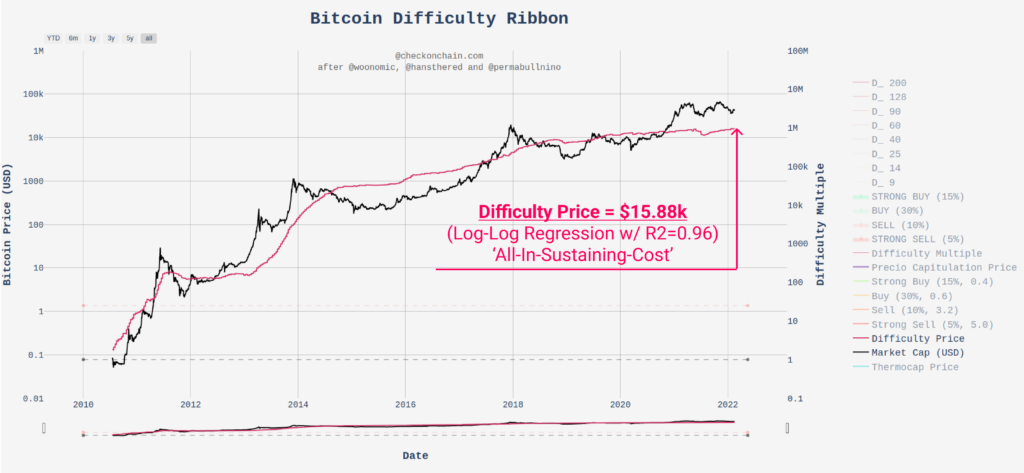
And when I see confirmation that the average mining price by a mining pool is $13K for S19 Pro rigs, it demonstrates just how good back of the envelope mathematics is.
The difference between $13.0K and $15.8K is the result of my calculation capturing the less efficient machines on the network, which raises the average price.
By keeping it simple, we can calculate 90% of the solution, and only worry about the nuance if we need to. This allows us to be more able, more reactive and perform sanity checks on a regular basis to keep our conclusions in check.