What is Bitcoin sniffing out? It is trading lower this week, and diverging from the upwards trend of mega-cap tech stocks. Is this underperformance or a signal something ain’t right?
Markets provide an endless stream of lessons and character-building events. More often than not, it teaches you something about your own thinking and decision-making process. The longer you spend in markets, the more your ‘spidey senses’ and gut instincts are tuned into identifying when things just don’t feel right.
Well, my spidey senses are tingling this week, and I wanted to dig into some data to find out why.
In this piece, I’ll share some thoughts that come straight from my gut instinct on the following:
- A potential unwind of the Bitcoin cash-and-carry trade affecting ETF and futures markets.
- An update on the ‘Top Heaviness’ of Bitcoin as price trades below the Short-Term Holder cost basis.
- The sustainability of the Nvidia parabola, which appears to be a black hole of liquidity, propping the entire U.S. stock market up.
Unwinding the Carry Trade
I recently covered the cash-and-carry trade that appeared to be driving a lot of ETF inflows. The juice within this arbitrage trade may be approaching the end of its useful squeeze.
Perpetual funding rates have compressed from 10% to just 6% over the last two weeks. This is marginally above the risk-free rate of cash equivalents, diminishing the incentive for traders to open and roll this trade forward.
Whilst this position is ‘delta neutral’ for the trader, it doesn’t mean it won’t have an impact on market pricing as the trades are entered and exited.
- The trader is long spot (via ETF) and short futures so they do not care which way prices go. When they want to unwind this trade, they must SELL the spot ETFs and LONG the futures.
- Futures markets are 10x bigger than spot, and can often absorb these kinds of positions without much issue.
- Spot and ETF markets are 10x smaller than futures, and are therefore more sensitive to one-sided orders like the unwind of cash-and-carry spot positions.
Trade volumes for the ETFs continue to be very light, suggesting there is less liquidity on the books to absorb the sold shares should this materialise, resulting in near-term supply headwinds.
Open interest on the CME exchange continues to match up with both inflows and outflows from the ETFs (excl GBTC). This suggests to me this trade unwind may be in play.
Not only does this allude to a general sell-side activity applied on the spot ETFs, but it is also not being countered by any appreciable inflows of new demand just yet.
Short-Term Sensitivity
Bitcoin is currently trading at $62.9k, which is below two important bull market price levels; the Short-Term Holder Cost Basis ($63.4k), and the 128-day moving average ($64.5k).
As we explored during the dip back in late April, this reflects a key decision point during a bull market:
- If the bulls are going to buy the dip, we’re now within their value zone.
- If the bears are in control, this is where they can seize the initiative.
The 200-day moving average (MA) is down at $57.6k, which I’d expect to step in as the plunge protection team should it be needed. The 200DMA also has confluence with the lows of the dip set back in May.
Short-Term Holders (STHs) are currently holding the largest volume of coins in loss since the August 2023 sell-off. Only 24% of STH coins are currently held in profit, which means three out of every four are held in loss. This increases the risk of price-sensitive holders selling out of fear.
We can see higher lows are developing on the volume of STH supply held in loss. This is a sign of acceleration taking place, and points to a progressive deterioration of profitability by this cohort.
This is something I’m closely watching, as we’re back into the ‘Cautious’ range by this metric.
With all of that said, the magnitude of unrealised losses remains pretty small on a relative basis. Whilst a large volume of STH coins are held below their cost basis, the USD value that this represents is roughly $14.3B, or just 1.4% of BTC’s market cap.
This tells me that a lot of STHs have a cost basis very close to where we currently are. The market is likely at a sensitive decision point, and are not too dissimilar to the conditions in late April.
STH-SOPR is back below 1.0, and remains within our expected bull market behaviour patterns. Brief, sharp, and somewhat shallow spikes below 1.0 are what I want to see.
Should STH-SOPR get down below 0.96 on a sustained basis, that would indicate that Bitcoin could in for something that requires tighter seatbelts.
On Nvidia: Instincts Only
I like to think I have a decent understanding about the way Bitcoin trades. Conversely, I know for sure that I have absolutely zero edge in understanding how Nvidia trades.
Nevertheless, the performance and concentration of capital in NVDA right now is a major factor setting off my spidey senses. It feels familiar.
The chart below shows the one-year performance of NVDA, Tesla (TSLA), Bitcoin, and the S&P 500 (SPX). I am of the view that Bitcoin is a potent ‘index of liquidity’, and when I see a divergence like this opening up, it makes me a bit uneasy.
My instinctual read is that Bitcoin may be sending us more accurate information about the liquidity picture than NVDA.
You may be wondering why I included Tesla in the previous chart.
It was the poster child for liquidity and excess in the 2020-21 cycle. Until very recently, it had technically outperformed BTC since the start of 2020. Nvidia, and the rhetoric around it, are giving me flashbacks to lessons I’ve learned throughout past market cycles.
When a price chart goes parabolic and vertical, it tends to sucker in the least sophisticated investors, right at the top. When even your Uber driver is max bidding call options on an asset…it is unlikely to be a sustainable move.
If we split performance by year since 2020, we see NVDA out-competing Bitcoin to the upside in 2021, 2022, and so far in 2024. Very few assets or asset classes can consistently pull this off, and the previous cycle’s chosen stock, TSLA, is paying its dues today.
Perhaps NVDA truly represents a new paradigm, because Bitcoin certainly is. However, when folks believe in new paradigms…it is usually getting late in the movie.
I’m not claiming that Bitcoin needs to be the best-performing asset each year, nor that Nvidia is destined to be the next Tesla (which is a company that never made sense to me). I have no edge or opinion either way.
However, my spidey senses tell me there is something off about a company adding $2 trillion (≈41M BTC) to the market cap in under six months, and it has me scared to look down.
For a sense of scale:
- Bitcoin added $1.1 trillion to its market cap between the FTX lows in Nov. 2022 and the $73k ETF peak in Mar. 2024 (16 months). I understand Bitcoin quite well, and can reason about how this happens. In my opinion, it was extremely undervalued in 2022, and heavily oversold by an enormous deleveraging across the entire industry.
- Nvidia added $2.0 trillion to its market cap this year alone, launching it to briefly become the most valuable company in the world last week. It is riding the AI wave as an infrastructure play, and to my limited understanding, has thus far displayed the revenue growth to support it.
Nvidia has even flipped bitcoin in Google search volumes, indicating that retail is currently less interested in internet money, and perhaps more interested in internet advice. This is more of a curiosity than a serious indicator, but one that really captures the zeitgeist of my instincts.
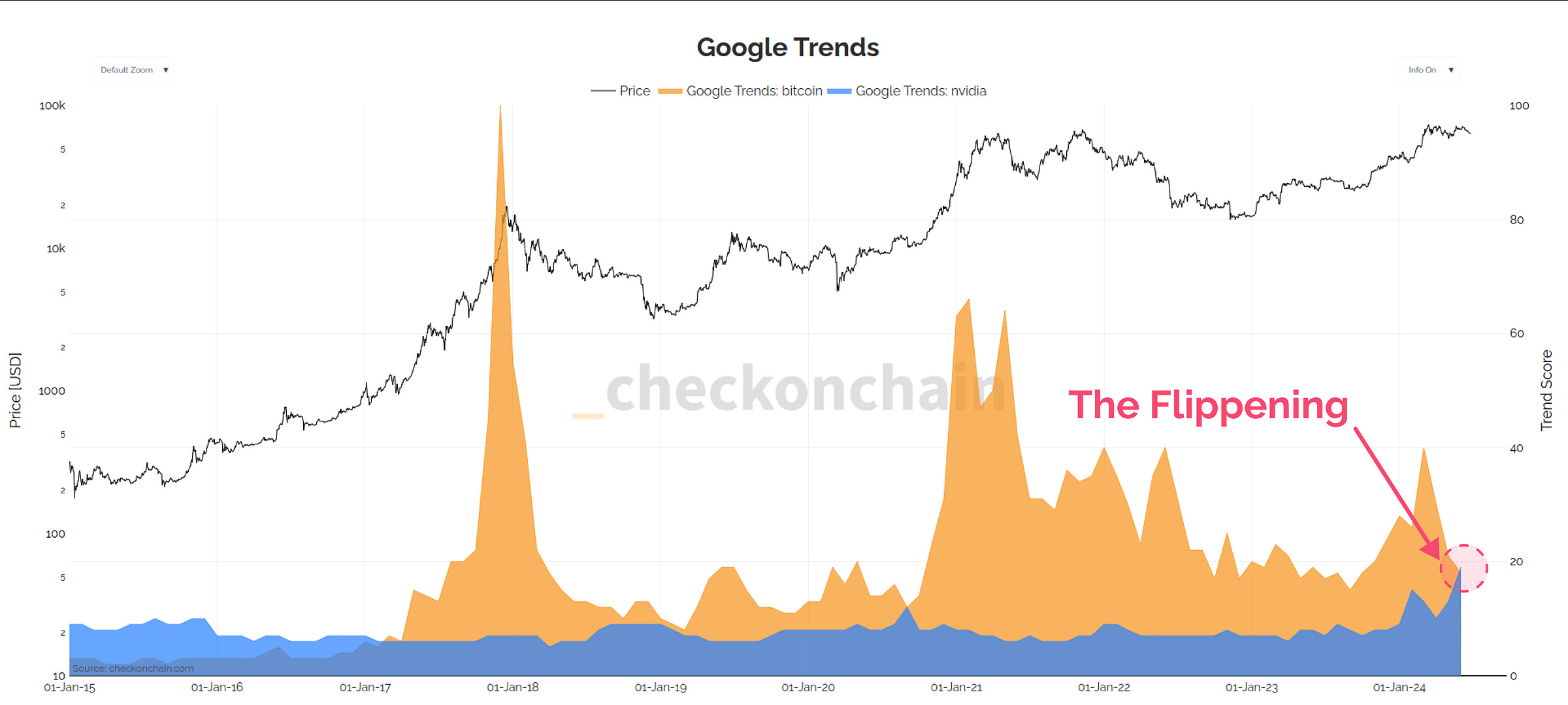 Source: Google Trends
None of this would be much of an issue if Nvidia was like GameStop, being just a ‘meme stonk’ that comes, goes, and transfers capital from one group to another. The problem with the NVDA situation is that a vertical parabolic chart is rarely sustainable…
…and this specific parabolic chart is currently holding up the performance of the US stock market…which is in turn holding up the U.S. economy…which is supporting the global financial system…
Concluding Thoughts
Let me reiterate that I have exactly zero edge, little insight, and few opinions either way about the performance of Nvidia as a stock or company. This may well be a very real and sustainable re-rating of the asset higher.
But the divergence between BTC and NVDA has my spidey senses tingling, nonetheless. What is Bitcoin sniffing out? Does it make sense for one stock to add 41M BTC in market cap in 180 days?
If we borrow lessons from the behaviour of short-term holders, what happens when too many people buy too many stocks, at too high of a price? Wouldn’t it be great if we had onchain metrics to analyse this for NVDA, too!
Given the high concentration risk of both capital, and index weighting towards the Mag-7 mega-caps, if any serious downside momentum is established in NVDA, it could quickly bleed out and affect everything else. Markets often require a catalyst to get moving, and there are few catalysts as powerful as lower prices. It helps flush out the weaker hands, and transfer assets back to the stronger hands.
Markets often have to go down, before they can go back up (and vice versa).
Another thesis I am playing with is what if the stock market is starting to trade more and more like crypto, where there are a small few winners, and lots and lots of losers? The volatility profile of Bitcoin isn’t all that different from the Mag-7 these days, anyway.
The Bitcoin spring is about as coiled as it gets, and perhaps some volatility in mega-caps is the catalyst the market has been looking for.
All of this falls into my ongoing chop-solidation thesis, within the context a longer-term macro-scale uptrend. However, I suspect we’re edging ever closer to the next chapter in this story, one where we finally manage to leave the woodshed behind us.
Thanks for reading,
James