Bitcoin is a macro asset. The honest reality is that it is impossible to fully appreciate its market moves without an overlay of macroeconomics.
And just to make matters more complicated, macroeconomics is a tricky beast that few actually understand anyway.
Nevertheless, I personally find it a fascinating puzzle that is never really solved. The edges keep changing, the colours of the pieces are always different, and it requires study of so many fields that it is endlessly interesting.
In our USD global reserve fiat currency regime, the bottom layer of the stack is the Treasury bill. This is a debt instrument issued by the US government and is supposed to represent the ‘risk-free rate of return’. An asset that cannot be defaulted on.
T-bills are issued with various duration to expiry, where the logic is that less risk is expect in 2-years vs 10-years. Thus, the yield on a 10y T-bill should theoretically be more than the 2-yr since more unknown risks need to be accounted for.
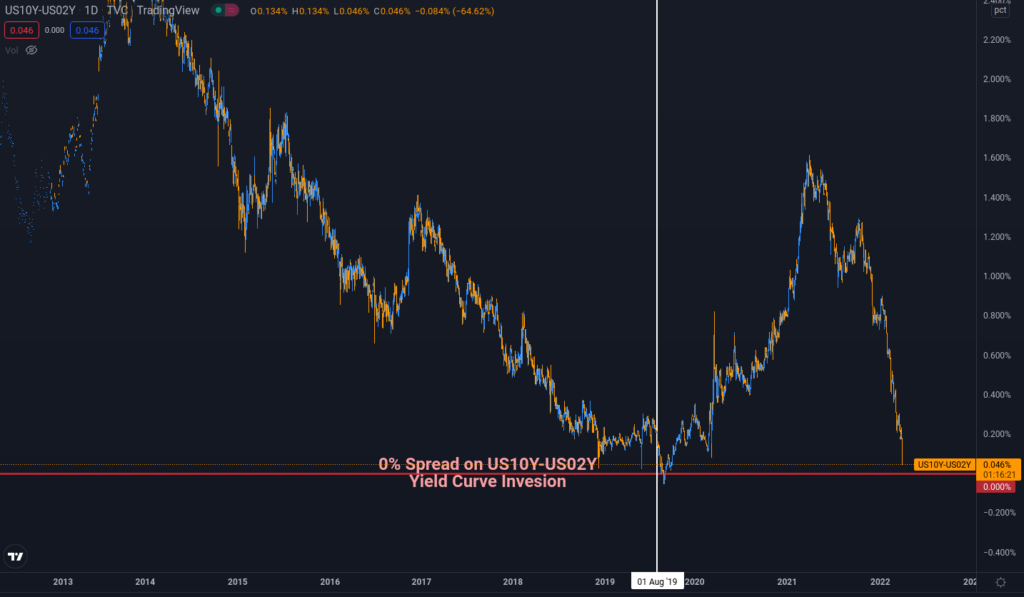
The chart below shows the US 10-year minus the 2-year yield, otherwise known as the yield curve. As you can see, we are approaching a 0% spread which is what is known as a yield curve inversion event. What this signals is the following:
- Investors are selling the 2-year bond more than the 10-year, which drives up the yield (as bond prices and yield are inversely correlated).
- Investors thus see more risk in the short term (inflation, war, energy prices etc) than in the long term.
- Higher rates make for tighter monetary conditions which in turn creates further economic slow-down.
- The market’s expectation is for more deflation in the long term, which signals more recessionary effects.
- When governments and central banks see the deflation nail then whip out their rates to zero and money printer hammer.
To help set expectations for what I believe is likely ahead in the next 12 months:
- We are most likely headed towards a global recession.
- This is likely to create both high volatility, and probable downside risk in all asset classes.
- The Fed is likely to raise rates into this mess, exacerbating the problem.
- Eventually, the pain of recession (unemployment, declining demand, even a debt crisis) will overwhelm the pain of inflation.
- At that stage, the central banks will most likely turn on the money printer to solve the problem.
- They wont solve the problem, but assets will ‘numba go up’.
The wonderfully (in)competent politicians of Australia have graciously provided us with a window into our future this morning, after releasing their federal budget. There are only two ways to deal with a recession, the first is austerity (tighten the belts, spend less, weather the pain), or the print money and ease with the risk of inflation as the price to pay.
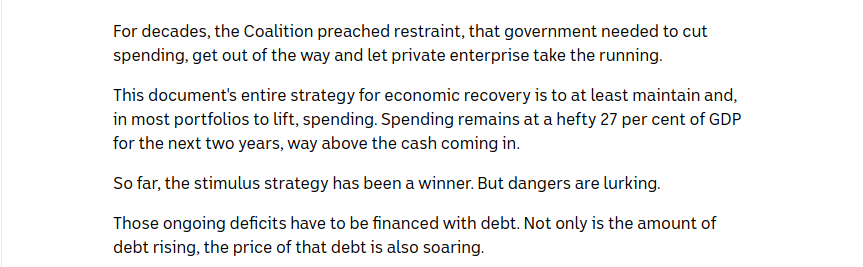
In case there was any doubts about whether austerity was on the table, here is a snippet detailing just how willing the traditionally fiscally ‘Conservative’ party of the Australian government is to go down this path. Apparently, the solution to inflation is cash handouts and an increase in government spending.
The hard reality, is given how in-debt the private, corporate and government sector all are, they actually don’t have a choice.

Lucky, we do have a choice. We have an immutable, perfectly scarce, and digital asset that responds quite well to the debasement of fiat currency…