← All Insights · SHIFT Method Strategy Guide
How to Build a Crypto Exit Strategy in 2026: The Profit Ladder
How to use Step T of the SHIFT Method (your Profit Ladder) to scale out of Bitcoin and altcoin positions systematically on the way up without guessing the exact market top.
“I have watched life-changing gains go to zero after not selling. And I’ve also made life-changing gains when I’ve actually implemented this profit taking strategy.” Ben Simpson
Quick answer
Quick Answer
Updated November 2026. General information only, not financial advice.
Crypto exit rules are decisions about when to sell, written down before the market gets exciting. A simple set covers four triggers: price levels for staged profit-taking, a maximum weight for any one position, a time or life-event review such as nearing retirement, and a rule for when to redeploy cash or stablecoins. The Profit Ladder below turns those rules into steps you can follow when emotions run hot. The Profit Ladder is Collective Shift’s written crypto exit strategy for taking profits in stages. If you file tax in the United States, use the US crypto exit strategy guide.
When should I sell crypto if nobody taught me how?
Decide before you need to. Write price levels where you will take part of your profits, a maximum size for any one position, and a review date. Selling in stages on a written plan removes most of the guesswork.
How do I write exit rules I will follow when emotions run hot?
Keep them short, specific and written in advance: what you sell, at what level, and how much. Set alerts rather than watching charts, and review the rules on a calendar date, not in the middle of a rally or a crash.
When should I redeploy profits held in stablecoins?
Set the redeploy rule at the same time as the sell rule, for example buying back in stages after a large fall or on a fixed schedule. Without a written rule, cash tends to sit idle or get spent at the wrong moment.
Planning ahead for your family? Read crypto inheritance planning in Australia.
Why buying is the easy decision
Buying crypto is the easy decision. You see a chart, you read a thesis, you click buy. Selling is the decision that actually decides whether you build wealth, and it is the one almost nobody plans for. After working with more than 1,000 members since 2020, the biggest problem I see is not picking the wrong coin. It is having no written plan for when and how much to sell.
On your first cycle this is especially hard, because you have never felt what a bull market does to your thinking. Everyone around you is euphoric, your portfolio is up more than you imagined, and the idea of selling feels like leaving money on the table. That feeling is exactly why a written exit strategy matters. You write it when you are calm, and you follow it when you are not.
This guide walks through the Profit Ladder, the framework we use inside Collective Shift and inside the Live Crypto Portfolio, and shows how it fits into the SHIFT Method so you can build your own version before the cycle peaks.
Key points from the video
- A profit ladder means taking profits in planned steps on the way up instead of trying to sell at the top.
- Ben notes that Bitcoin has historically spent only about 20 to 25 days within the top 10 percent of a cycle, and smaller coins far less, so picking the top is unrealistic.
- Four common sell triggers are price targets, time windows, selling a set amount on a schedule (DCA out) and profit thresholds.
- Each rung needs a purpose, a trigger, an amount, an execution route and a destination for the proceeds.
- Set realistic goals. Goals the market cannot deliver stop people from taking profits at all.
- Finish with downside rules and a one page exit plan, and reassess any coin whose original thesis has broken.
What is a crypto profit ladder?
A plan to sell portions of a holding at set steps as prices rise, so you lock in some gains without needing to pick the exact top.
What goes on a one page exit plan?
Your purpose, the trigger for each sale, the amount, where you will sell, and where the proceeds will go.
Summary of Ben Simpson’s video on building a crypto profit ladder, written from the video transcript. General education only.
My Crypto Profit-Taking Strategy: When and How Much to Sell
The four selling scenarios
There are four real selling scenarios I see people go through. The first is the genius scenario, where you try to sell at the absolute top. Everyone aspires to this, but it is not reality. We analysed how long the top of a cycle actually lasts. Bitcoin historically spends only about 20 to 25 days within the top 10% of its cycle price, so less than a month. The top 10 coins spend less than a week there. Lower cap altcoins, like the meme coins of the previous cycle, can spend less than a day, sometimes only hours.
The lower the market cap, the higher the volatility and the harder it is to predict. So we are not trying to be geniuses. The problem is that the genius scenario quickly turns into the oh no scenario. You set a target, or you go on gut feel, and when price gets there you move the target. People were talking about a certain Bitcoin price, then double that, then a million, and everyone gets euphoric. Those most euphoric moments are usually exactly when the market turns.
The third scenario is the never sell scenario, where you hold through the top and ride it all the way back down, round-tripping life-changing gains. The fourth is the planned scenario, where you scale out in stages on the way up using rules you wrote in advance. That fourth scenario is the Profit Ladder.
What the Profit Ladder is
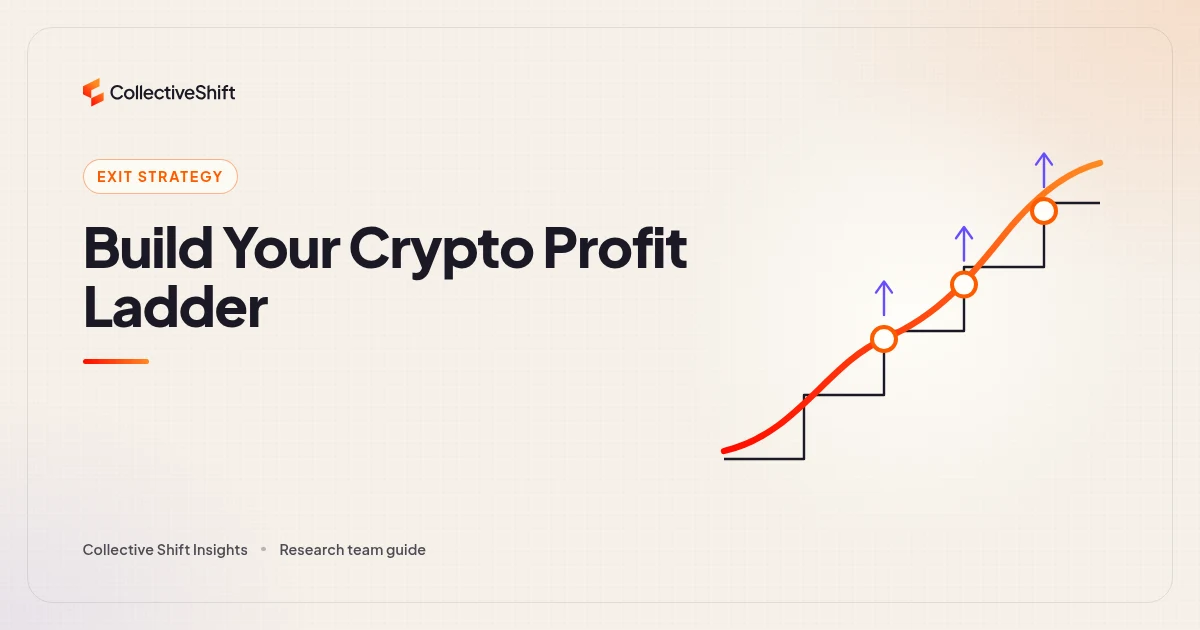
The Profit Ladder is a pre-planned, staged approach to taking profits. Instead of one big sell decision at a single price, you set a series of rungs. Each rung is a price level or a market condition where you sell a defined portion of a position. Lower risk assets like Bitcoin get wider, later rungs. Higher risk on-chain businesses and smaller altcoins get earlier and more aggressive rungs because their tops are shorter and sharper.
The point of the ladder is not to sell at the top. It is to make sure you sell something on the way up, every time, so the gains become real. You accept that you will leave some upside on the table in exchange for never giving all of it back.
I still remember feeling physically nauseous when I took profits in 2021. Every part of me wanted to hold on. Following the plan anyway is one of the best financial decisions I have made, and it is the reason I teach the ladder to every member.
The SHIFT Method
The SHIFT Method: 5 steps every Collective Shift member follows
- S: Set your plan in writing (your Strategy Sheet)
- H: Hold Bitcoin as your core
- I: Invest in on-chain businesses with real revenue
- F: Filter every coin before you buy
- T: Take profits on the way up (your Profit Ladder)
How the Profit Ladder fits into the SHIFT Method
The Profit Ladder is the T in the SHIFT Method: take profits on the way up. It only works if the other four steps are in place. You set your plan in writing on your Strategy Sheet, so your rungs exist before the euphoria starts. You hold Bitcoin as your core, so the bulk of your wealth sits in the asset with the longest track record and the longest cycle tops. You invest in on-chain businesses with real revenue, so the higher risk part of your portfolio has fundamentals you can measure. And you filter every coin before you buy, so you are not laddering out of positions you never should have owned.
When members skip the written plan, the ladder falls apart. A plan in your head can be renegotiated at 2am when the market is ripping. A plan on paper, with specific percentages and specific levels, is much harder to argue with.
Step by step: building your own Profit Ladder
Step one is to list every position and classify it as core, on-chain business, or speculative. Your core is Bitcoin. On-chain businesses are protocols generating real revenue. Speculative positions are everything else, and they should be small.
Step two is to decide your total target. How much of your portfolio do you want converted to stablecoins, cash or Bitcoin by the end of the cycle? Write the number down. For many members it is a meaningful share of their altcoin exposure and a smaller share of their Bitcoin.
Step three is to set the rungs. A simple example is selling a portion of each altcoin position every time it doubles from your average entry, or every time it hits a level you defined in advance. For Bitcoin, the rungs are usually later and smaller, with more weight on market cycle signals than on price alone.
Step four is to decide where the profits go. Some members move profits into stablecoins to redeploy in the next bear market. Some rotate altcoin profits back into Bitcoin to grow their core stack. Some take money off the table entirely for a house, a business or their family. All three are valid. What matters is that the destination is written down.
Step five is tax. In Australia, every sale is a capital gains event. Speak to a crypto tax accountant about timing, the 12-month CGT discount, and whether an SMSF or company structure suits you before you start selling. Ben learnt this the hard way when he started Collective Shift.
A real example from the Live Crypto Portfolio
On 3 June 2026 our analysts sold one third of the HYPE position in the Live Crypto Portfolio into stablecoins. It is a simple example of a Profit Ladder rung being taken on the way up, with the decision dated and explained to members in the Live Crypto Portfolio.
That is the whole idea behind the Live Crypto Portfolio: see our analysts’ portfolio buys and sells, dated and explained, so you can see a Profit Ladder being executed in real time rather than in theory. Together with, not instead of. We don’t manage your money. We show you every decision we make with ours, and help you write your own version of each one.
This is a historical example for education only and not a recommendation to buy or sell HYPE or any other asset.
The Live Crypto Portfolio: see our analysts’ portfolio buys and sells, with a dated thesis for every entry and every Profit Ladder trim.
Together with, not instead of. We don’t manage your money. We show you every decision we make with ours, and help you write your own version of each one.
Profit Ladder Worksheet
Your Profit Ladder Worksheet: How Much to Sell, When, and the Tax
A Profit Ladder only works if it is written down before prices move. Use this worksheet as a template for your own plan. The multiples below are an example for education, not a target or a prediction.
| Rung | Example trigger | Example action | Why |
|---|---|---|---|
| Rung 1 | Position is up 2x on your average cost | Sell 10 to 20 percent of smaller coins | Recovers part of your starting capital |
| Rung 2 | Position is up 3x | Sell another 10 to 20 percent and set aside tax | Locks in gains while keeping exposure |
| Rung 3 | Position is up 5x, or the market looks euphoric | Trim Bitcoin lightly and move profits to your chosen destination | Protects the plan when emotion is highest |
| Review | Each quarter | Check targets against your written plan, never move them up | Stops the ladder turning back into one big bet |
Bitcoin and altcoins need different ladders
In the 5-step SHIFT Method (Set your plan in writing, Hold Bitcoin as your core, Invest in on-chain businesses with real revenue, Filter every coin before you buy, Take profits on the way up), Bitcoin is the core, so it is usually trimmed last and in small slices. Altcoins have historically fallen further in bear markets, so their ladder usually starts earlier. Our 100K to 500K allocation guide shows how the core and satellite pieces fit together.
Plan for tax before you sell
Selling or swapping crypto is generally a capital gains tax event in Australia. Individuals who hold an asset for at least 12 months may be eligible for the 50 percent CGT discount, so the timing of each rung can change how much tax you pay. The official guidance is at ATO: Crypto asset investments. Keep records of every buy and sell, and speak with a registered tax agent before a large sale.
Ben explains how to take profits in stages so a bull market ends with money in the bank, not just gains on screen. From the Ben Simpson YouTube channel.
Quick questions
How much crypto should I sell at each rung of a Profit Ladder?
Many investors sell a set share of the position at each rung, for example 10 to 20 percent, so no single decision matters too much. The exact share depends on your goals, your tax position and how much you want to keep for the long term. Write it down before the market gets euphoric.
Should I take profits on Bitcoin and altcoins the same way?
Usually not. Smaller coins have historically risen and fallen faster than Bitcoin, so many investors start trimming them earlier and in larger slices, while Bitcoin, as the core of the portfolio, is trimmed later and more slowly.
Does taking profits trigger tax in Australia?
Yes. Selling or swapping crypto is generally a capital gains tax event in Australia. If you held the asset for at least 12 months, you may be eligible for the 50 percent CGT discount as an individual. Check the ATO guidance and speak with a registered tax agent.
What should I do with profits once I sell?
Decide before you sell. Common destinations are a cash buffer, paying down debt, set aside tax, or long term assets outside crypto. Profits without a destination tend to end up back in the next hot token.
Written by Ben Simpson, founder of Collective Shift and TEDx speaker, and reviewed by Matt Willemsen, Director of Research. As of November 2026.
General information only, not personal financial advice. Collective Shift provides research and education. Consider your own circumstances and speak with a licensed financial adviser before acting.
Common mistakes to avoid
The first mistake is moving your targets up as price rises. If you find yourself doing this, it is the oh no scenario starting. The second mistake is selling everything at once, which turns the ladder back into a single genius bet. The third mistake is laddering out of Bitcoin too early while holding small caps far too long, which is the reverse of how cycle tops actually behave. The fourth is ignoring tax until June. The fifth is having no destination for the profits, so they simply get gambled back into the next hot token.
Every one of these mistakes comes from the same root cause: no written plan. Fix that first and most of the rest fixes itself.
Your next step
Open a blank page today and write three things: which positions you hold, how much of each you will sell and at what rungs, and where the profits will go. That is the start of your Strategy Sheet. If you want a structured process and to see our analysts executing their own ladder, read member reviews on our reviews page, then join the free newsletter or explore Collective Shift membership.
Frequently asked questions
What is a crypto exit strategy?
A written plan for when and how much of each position you will sell, decided before the market becomes euphoric.
What is the Profit Ladder?
Collective Shift’s staged profit-taking framework: you sell defined portions at pre-set rungs on the way up instead of trying to sell the top.
How long does a Bitcoin cycle top last?
Historically Bitcoin spends about 20 to 25 days in the top 10% of its cycle price. Smaller coins spend far less.
General information only. Collective Shift provides research and education, not personal financial advice. We don’t manage your money or hold your crypto. Consider your own circumstances and speak with a licensed adviser and a registered tax agent before acting. Past performance is not a reliable indicator of future performance.
Your Digital Asset Co-Pilot
Turn Noise Into Strategy. Turn Strategy Into Wealth.
You keep the controls while our research analysts sit in the co-pilot seat. Book a private 1-on-1 strategy call to map your Strategy Sheet, the 5-step SHIFT Method, and the right Collective Shift membership for your portfolio.
5-Step SHIFT Method 4.8 out of 5 from 135+ verified Trustpilot reviews · 1,000+ Members 100% Self-Custody & Independent Research
Collective Shift Research Architecture
How the 5-Step SHIFT Method Fits Together
Every research note inside Collective Shift maps directly to the 5-step SHIFT Method so you stay in control of your capital.
Our Process
The 5-Step SHIFT Method
Every Collective Shift membership runs on the same five-step operating system. Process comes first, proof comes second, and outcomes follow from written rules rather than emotion.
S
Set Your Plan in Writing
Build your written Strategy Sheet before deploying capital so position sizing, risk limits, and invalidation rules are locked in advance.
H
Hold Bitcoin as Your Core
Anchor your portfolio around long-term Bitcoin conviction in 100% self-custody before taking selective altcoin exposure.
I
Invest in On-Chain Revenue
Focus on on-chain businesses with real fee generation, sustainable tokenomics, and verifiable user adoption, alongside the Live Crypto Portfolio (see our analysts’ portfolio buys and sells).
F
Filter Every Coin First
Run every asset through our Fundamental Asset Evaluation Framework, checking token unlock schedules, dilution, and liquidity before buying.
T
Take Profits on the Way Up
Execute pre-planned partial exits using your Profit Ladder so paper gains convert into realised wealth without guessing the exact cycle top.
More guides
Emotional crypto investing: how to stop panic selling On-chain analysis explained
If you would rather sell on a fixed schedule than at price targets, read our guide to dollar cost averaging selling.