US Guide
Crypto Exit Strategy: When to Sell and How to Take Profits in 2026
From Collective Shift, founded in 2020 by TEDx speaker Ben Simpson and built on the 5-step SHIFT Method. Updated November 2026.
Written by Ben Simpson and reviewed by Matt Willemsen. Published November 3, 2026. Updated November 3, 2026.
Compare Memberships Book a Free Strategy Call
The Short Answer
A crypto exit strategy is a written plan that says when you will sell, how much you will sell each time and what you will do with the proceeds, decided before prices rise. Most long-term investors sell in stages on the way up rather than trying to pick the exact top. For US investors, the plan should also cover IRS tax timing, because coins held for more than one year generally qualify for lower long-term capital gains rates.
As of November 2026. General information only, not personal financial, tax or legal advice. Speak with a licensed US tax professional or financial advisor about your own situation.
Why You Need an Exit Strategy Before You Buy
Buying is the easy decision. Selling is harder, because the moment to sell usually arrives when everyone around you expects prices to keep rising. Crypto has a history of sharp reversals: the total crypto market fell 48% from its October 2025 peak by June 2026 (The Kobeissi Letter, 5 June 2026), and Bitcoin has fallen more than 70% from a peak several times.
A written exit strategy takes the decision out of the moment. You set the rules while you are calm, then follow them when the market is loud. In the 5-step SHIFT Method taught by TEDx speaker Ben Simpson, this is Step T: Take Profits on the Way Up.
Watch: Ben Simpson Explains
Ben Simpson walks through how he plans when and how much to sell in a strong market, and why the rules are written before the rally.
Key points from the video
- A profit ladder means taking profits in planned steps on the way up instead of trying to sell at the top.
- Ben notes that Bitcoin has historically spent only about 20 to 25 days within the top 10 percent of a cycle, and smaller coins far less, so picking the top is unrealistic.
- Four common sell triggers are price targets, time windows, selling a set amount on a schedule (DCA out) and profit thresholds.
- Each rung needs a purpose, a trigger, an amount, an execution route and a destination for the proceeds.
- Set realistic goals. Goals the market cannot deliver stop people from taking profits at all.
- Finish with downside rules and a one page exit plan, and reassess any coin whose original thesis has broken.
What is a crypto profit ladder?
A plan to sell portions of a holding at set steps as prices rise, so you lock in some gains without needing to pick the exact top.
What goes on a one page exit plan?
Your purpose, the trigger for each sale, the amount, where you will sell, and where the proceeds will go.
Summary of Ben Simpson’s video on building a crypto profit ladder, written from the video transcript. General education only.
What a Good Exit Plan Includes
| Part of the plan | What you write down |
|---|---|
| Your goal | What the money is for: a home, retirement, paying off debt or simply growing wealth |
| Price or valuation levels | The points where you will sell part of each position |
| How much each time | A set share of the position at each level, such as a quarter or a third |
| Where proceeds go | Cash, stablecoins, index funds, paying down debt or rebalancing into Bitcoin |
| Tax timing | Which lots you sell first and whether you wait for the one-year mark |
| Review dates | When you check the plan, for example once a quarter |
Keep it to one page. If you cannot explain your plan in a few lines, it will be hard to follow when prices move fast.
The Profit Ladder: Selling in Stages
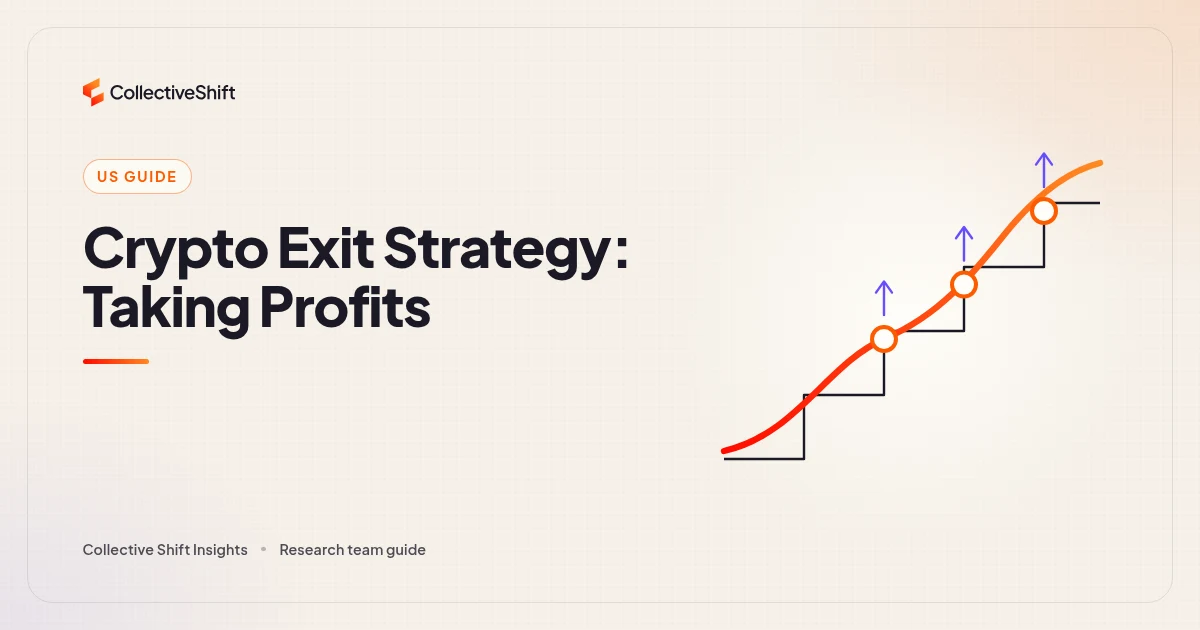
A Profit Ladder is a set of steps where you sell part of a position at each level as prices rise. It accepts that nobody can reliably call the top. Instead of one big sell decision, you make several small ones that are already decided.
A simple example: you sell a third of a position each time it doubles. If prices keep rising, you still hold part of the position. If prices reverse, you have already locked in gains. The exact levels matter less than having them in writing before the rally starts.
Our full walkthrough, written for Australian readers, is the Profit Ladder exit strategy guide. The steps are the same in the US; the tax rules below are what change.
How Our Team Takes Profits
In the Academy module on goal setting and profit taking, the team starts with a question: what does success look like for you? Growing wealth, beating inflation and paying off a mortgage each lead to a different sell plan. The module also covers stablecoins, which are tokens designed to track the US dollar, as a way to lock in gains without leaving crypto entirely.
In our live cohort on building a sell plan, one example the team shares is taking a third of a position off each time it doubles. The analyst who used it was clear that it is not a crystal ball and not better or worse than a quarter or a half; it is a personal choice. What matters is that the rule is written down before prices move.
How the IRS Taxes Selling Crypto
The IRS treats digital assets as property, so selling, swapping or spending crypto can create a capital gain or loss. Coins held for more than one year generally qualify for long-term capital gains rates, which are usually lower than the short-term rates that apply to holdings of one year or less.
That makes the calendar part of your exit plan. A sale a few weeks before the one-year mark can cost more tax than the same sale a few weeks later. From the 2025 tax year, brokers report sales on Form 1099-DA, and each sale goes on Form 8949. Our US crypto tax guide covers the forms, and our crypto wash sale guide explains how losses are treated. A licensed US tax professional can confirm how this applies to you.
Where the Proceeds Go
Selling is only half the plan. Decide in advance where the money lands. Common choices are cash for a near-term goal, stablecoins (tokens designed to track the US dollar) if you plan to buy again later, a diversified index fund, or paying down high-interest debt.
Some investors use part of their profits to add to their Bitcoin core, which is Step H of the SHIFT Method. Whatever you choose, write it next to each step of your ladder so the decision is made before you need it.
Five Mistakes That Wreck an Exit Plan
- Waiting for the exact top, then selling after a large fall instead
- Moving the targets higher every time prices reach them
- Selling everything at once, with no plan for what happens if prices keep rising
- Ignoring the one-year mark and paying short-term rates by accident
- Never reviewing the plan as your goals, income or portfolio size change
How Our Team Thinks About Market Cycles
In an October 2026 live cohort session, Ben Simpson described how crypto has more or less followed four-year cycles, with bull markets running around three years and bear markets around one, while stressing that it is not as simple as that. On-chain analyst Checkmate, who writes the on-chain analytics column on our site, puts it this way: he respects the four-year cycle as a framework but does not anchor his view to it.
That is why the SHIFT Method uses a written plan instead of a prediction. The total crypto market fell 48% from its October 2025 peak by June 2026 (The Kobeissi Letter, 5 June 2026). A plan written before a fall like that is the one you are most likely to follow during it.
Exit Strategy in the SHIFT Method
Your exit plan sits on your Strategy Sheet alongside your goals and position sizes. In the Collective Shift Accelerator, members build it in a live four-week cohort and test it with an analyst; Platinum members review it in private 1-on-1 educational sessions. You make every decision yourself.
S
Set Your Plan in Writing
Write down your goals, position sizes and exit rules on your Strategy Sheet before any money moves.
H
Hold Bitcoin as Your Core
Bitcoin sits at the center of the portfolio, held in your own self-custody.
I
Invest in On-Chain Businesses
Look for on-chain businesses with real revenue and real users.
F
Filter Every Coin Before You Buy
Check token unlocks, dilution and liquidity, so a good story is never the only reason for a position.
T
Take Profits on the Way Up
Your Profit Ladder sets out in advance when you take partial profits as prices rise.
Questions
Frequently Asked Questions
Quick answers for US readers.
When should I sell my crypto?
There is no single right time. Many long-term investors sell in stages as prices rise, using levels they wrote down in advance, rather than trying to sell everything at the top.
How much crypto should I sell at each step?
Common approaches sell a quarter or a third of a position at each level. The right share depends on your goals and how much of the position you want to keep for the long term.
Do I pay tax when I take profits in crypto?
In the US, selling, swapping or spending crypto can create a capital gain or loss. Holdings kept for more than one year generally qualify for long-term capital gains rates.
Should I sell crypto into stablecoins?
Some investors do so they can buy again later without leaving crypto. Swapping into a stablecoin is still a taxable sale in the US, and stablecoins carry their own risks.
What is a Profit Ladder?
A set of price or valuation levels where you sell part of a position, written down before prices rise. It is Step T of the SHIFT Method.
Does Collective Shift tell me when to sell?
No. Collective Shift provides general research and education. We teach a process so you can make your own decisions; we do not give personalized advice or manage money.
This page is general information only and does not consider your objectives or circumstances. Speak with a licensed US tax professional or financial advisor before acting. US office: Atlanta, Georgia. Collective Shift, Inc., 505 N Angier Ave NE, Floor 3, Atlanta, GA 30308. Email [email protected]. Collective Shift, Inc. is a Delaware corporation and part of Collective Shift (Collective Shift Pty Ltd, ABN 78 650 977 325, Australia), a research and education company. We do not manage money or hold client funds. Looking for our Australian site? Visit the Australian page.
Build Your Plan With Collective Shift
Book a free 30 to 45 minute strategy call and we will work out together whether the Accelerator or Platinum suits you.
Free call. No obligation.