Short answer. Uniswap is a decentralised exchange that lets you swap tokens straight from your own wallet across Ethereum, Base, Arbitrum, Polygon and other networks. Instead of an order book, trades run against liquidity pools priced by a formula. Connect a wallet, pick the two tokens, check the fee and price impact, then confirm.
Last updated 30 October 2026
What Is Uniswap?
Uniswap is one of the most popular ways that people swap cryptocurrencies on the Ethereum blockchain. Every month, tens of billions of U.S. dollars worth of cryptocurrencies are traded on Uniswap.
People use the Uniswap protocol because it lets them:
- Buy tokens that may not be listed on more popular exchanges.
- Earn income by sending their tokens to a liquidity pool.
- Exchange tokens without needing to do KYC.
How Uniswap Works
Whereas most exchanges maintain an order book and facilitate matches between buyers and sellers, Uniswap smart contracts hold liquidity reserves of various tokens. Trades are executed directly against these reserves.
Prices are set automatically using a simple math equation. The fees for swapping tokens are very small, ranging between 0.05% and 1.00%.
Swapping Tokens on Uniswap
For most people, swapping tokens is the only thing they’ll ever use Uniswap for. This can be done from Uniswap’s open-source interface.
To do a swap, you need one of the following wallets: MetaMask, WalletConnect, Coinbase Wallet, Fortmatic or Portis. Assuming you have one of these, click ‘Connect to a wallet’.
Related: How to Use MetaMask Wallet
Next, choose the 2 tokens you want to swap. You will need to select a token list such as Uniswap Default List. You can find a token by searching for its name or symbol or by pasting its address in the search bar.
Adding Liquidity to a Uniswap Pool
Behind swapping, providing liquidity is the most popular thing people use Uniswap for. They do this to earn income, which comes from the 0.05 to 1.00% fee that is automatically charged on each trade.
Fees are shared pro-rata between all liquidity providers to a given liquidity pool. (A liquidity pool is simply a smart contract and is itself an ERC-20 token.) Anyone can become a liquidity provider for a pool by depositing an equivalent value of each underlying token in return for pool tokens.
Risks With Uniswap
Fake tokens
Because Uniswap is permissionless, anyone can list fake tokens in the hope that people will mistakenly send tokens to the fake token’s address. The core Uniswap team combatted this in Aug. 2020 by introducing Token Lists. As per the below excerpt from Uniswap’s blog post:
As the rate of token issuance accelerates, it has become increasingly difficult for users to filter out high quality, legitimate tokens from scams, fakes, and duplicates. Across the space, projects are managing and maintaining rapidly growing token lists. The end result is a lot of wasted time, slow listing processes and scammed users.
Phishing attacks
While this risk isn’t inherent to Uniswap, it is definitely something to note. Scammers continue to create phishing copies of Uniswap’s interface.
Sometimes these scam websites appear on the top of the Google search results as an ad when you search for ‘uniswap’.
Always ensure you are on https://app.uniswap.org/#/ swap before making a swap. If you use MetaMask, you can always verify you are using the real Uniswap interface by clicking the 3 dots and then clicking ‘connected sites’.
To lower the risk you land on a phishing copy of the Uniswap interface, consider bookmarking the real interface and clicking that bookmark whenever you want to use Uniswap.
Related: Tips on Avoiding Crypto & NFT Scams
Smart contract risk
While Uniswap’s smart contract code is relatively lean and simple, it is always possible that a bug in one of Uniswap’s smart contracts is identified and exploited.
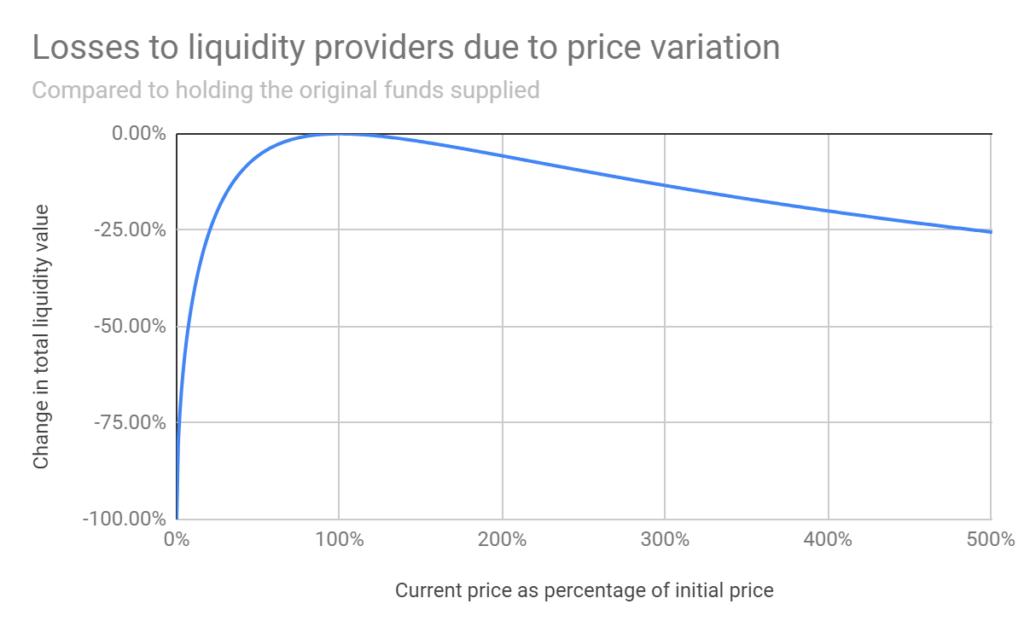
Divergence loss
Liquidity providers can lose money, compared to if they simply held their tokens and never provided liquidity, when the underlying token’s price significantly increases or decreases. This loss is only realised when the liquidity provider withdraws their liquidity.
The more volatile the price action of the underlying token, the more the liquidity provider loses relative to if they simply never provided liquidity. (More about divergence losses in Uniswap.)
FAQs
My transaction is pending for X hours/days but it doesn’t show up on Etherscan. Your transaction was likely dropped from the mempool, meaning it will likely never succeed. To remove this pending transaction, you must reset your wallet and Uniswap. If you’re using MetaMask, you can reset your account to clear pending transactions. Then, to clear pending transactions from the Uniswap interface, click your account and select ‘clear all’ above your list of transactions.
My transaction failed. Can I get my fees back? No. When your transaction fails for any reason, you permanently forfeit the gas fees used to pay miners. However, the fee you paid for a failed transaction is usually less than you would pay for a successful one.
What is UNI? UNI is an ERC-20 token that enables shared community ownership and a governance system, which is limited to contributing to both development and usage as well as development of the broader Uniswap ecosystem. The total supply of UNI is 1,000,000,000.
Want to know more about SushiSwap, an exchange that is similar to Uniswap? Watch the below video from the Collective Shift YouTube channel.
Uniswap and SushiSwap are examples of decentralised exchanges (DEXes). Learn more about them in What Is A Decentralised Exchange (DEX)?.
Watch: Ben Simpson on this topic
Key takeaway: Ben explains where decentralised exchanges such as Uniswap fit alongside a regular exchange in a long-term crypto strategy, and what you need in your wallet before you swap.
Key takeaway: Ben uses Uniswap as an example of why a great product and a great token are not the same thing, and what to check in token economics.
What Collective Shift research says about Uniswap in 2026
The Collective Shift Knowledge Hub lists Uniswap as the decentralised exchange members use to trade tokens directly from their wallets across Ethereum, Base, Arbitrum, Polygon and other EVM chains.
Our research team has long separated the product from the token. In the June 2026 altcoin research session the team noted that a good project does not necessarily mean a good token. That is starting to change: on 23 October 2026 the Research Hub reported that Uniswap v4 aggregator hooks went live on Ethereum, Base and Robinhood Chain, and that protocol fees from swaps routed to outside venues now contribute to UNI token burns.
- Swap from a self-custody wallet such as MetaMask.
- Check you are on the official Uniswap site before you connect.
- Review the network fee and price impact before you confirm.
- Treat the UNI token as a separate investment decision from using the app.
“Uniswap's a great product. In fact, I love using Uniswap, but a lot of the token revenue or the revenue from the protocol doesn't go back to the token.”
Ben Simpson, Founder of Collective Shift (December 2025), in Exactly How I Research and Invest In Crypto Altcoins in 2026
Where this guide comes from
This guide is written and reviewed by the Collective Shift research team. Collective Shift is a crypto research and education company founded in 2020 in Melbourne, and a research and education partner to Coinbase, Swyftx and CoinSpot. Sources used in this update:
- Video: Exactly How I Research and Invest In Crypto Altcoins in 2026, Ben Simpson on YouTube (2025-12-07)
- Video: How To Build A $1M+ Crypto Investing Strategy (Step-By-Step), Ben Simpson on YouTube (2026-08-27)
- Collective Shift Knowledge Hub: Knowledge Hub tool profile: Uniswap (May 2026) (ref 1e97cd86), original source: app.uniswap.org
- Collective Shift Knowledge Hub: Research Hub: Uniswap v4 aggregator hooks go live (23 Oct 2026) (ref 15416288), original source: www.theblock.co
- Collective Shift Knowledge Hub: Our Approach to Altcoin Research, research team session (Jun 2026) (ref f1c282e7)
Last updated 30 October 2026. General information only, not financial advice. Consider your own circumstances and seek professional advice before making investment decisions.
Frequently Asked Questions
Do I need to do KYC to use Uniswap?
No. Uniswap’s interface connects to your own wallet, so you do not open an account. You still need a centralised exchange or other on-ramp to buy your first crypto with Australian dollars.
What changed for the UNI token in October 2026?
Collective Shift’s Research Hub reported on 23 October 2026 that Uniswap v4 aggregator hooks went live on Ethereum, Base and Robinhood Chain. Protocol fees from swaps routed through outside liquidity now contribute to UNI token burns.
Where can I learn to use DeFi as part of a plan?
The Collective Shift Accelerator membership is a 12-month guided program that starts with 4 live weeks. More free guides are on Collective Shift Insights.