Beginner Guide
Crypto Trading Strategies for Beginners: An Educational Guide
Key points
- A strategy is a set of rules you decide in advance, not a prediction about where prices go.
- Simple approaches such as dollar cost averaging and rebalancing are easier to stick to than frequent trading.
- Planning how and when you will take profits matters as much as planning what you buy.
- Position sizing and avoiding leverage protect you from the mistakes every beginner makes.
Start with a plan, not a prediction
Most beginners lose money by reacting to headlines and price moves rather than following rules. A strategy is simply a set of decisions made in advance: how much you will put in, how often, what you will hold, and what will make you sell. Writing it down before you start is the single most useful habit, because it gives you something to follow when markets get loud.
This guide explains common approaches so you understand how they work. It is education, not a recommendation of any strategy or asset for your situation.
Dollar cost averaging (DCA)
Dollar cost averaging means investing a fixed amount on a regular schedule, such as every week or month, regardless of price. When prices are lower your amount buys more, and when prices are higher it buys less. It removes the pressure of trying to pick the perfect moment.
The trade off is that in a market that rises steadily, putting in a lump sum earlier would have bought more. Our guide to DCA vs lump sum compares the two in more detail.
Buy and hold
Buy and hold means choosing assets you have researched and holding them through ups and downs, often for years. It keeps fees and tax events low and stops you from trading on emotion. Crypto communities call this HODL.
The risk is holding something whose story has broken. Holding works best when you review your reasons on a schedule, not when you ignore your portfolio entirely.
Rebalancing and position sizing
Position sizing is deciding how much of your portfolio goes into each asset before you buy. Many people keep larger, more established assets such as bitcoin as a bigger share and limit smaller, riskier altcoins to a smaller share. Our guide to splitting a portfolio between bitcoin and altcoins explains the thinking.
Rebalancing means returning to your chosen mix when prices move it out of line, either on a set schedule or when an asset drifts too far. It forces a habit of trimming what has run up and topping up what has lagged, rather than chasing whatever is moving.
Plan your profit taking in advance
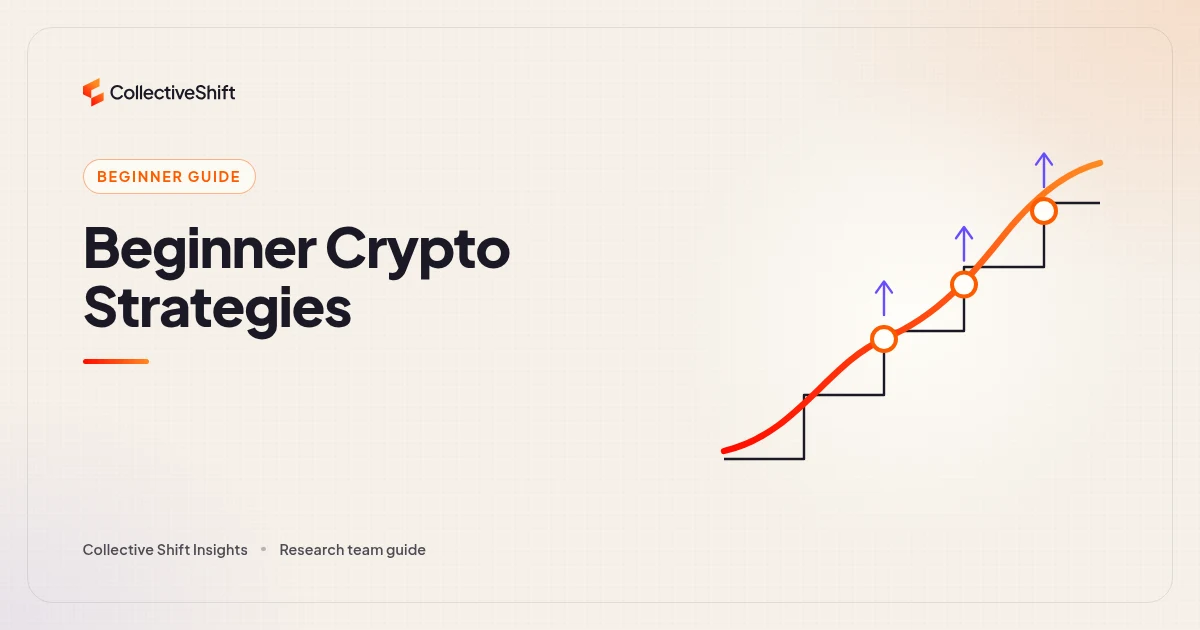
Many people plan their buying carefully and never plan their selling. A profit taking plan sets out, in advance, the points at which you will sell part of a position. At Collective Shift we teach this as the Profit Ladder, which spreads selling across several steps rather than trying to sell everything at the top. Our guide to building a crypto exit strategy walks through how it works.
Active trading approaches, and why beginners should be careful
You will also hear about swing trading, which tries to catch moves over days or weeks, and day trading, which opens and closes positions within a day. These rely on timing and discipline, and frequent trades add fees and tax records. Many add leverage through futures, which can wipe out a position quickly. If you explore them, start small, keep a trading journal and never use money you need.
Common mistakes to avoid
- Buying because something is trending on social media without understanding it.
- Putting in more than you can afford to see fall a long way.
- Using leverage before you understand liquidation.
- Selling everything in a panic during a fall, or buying everything in excitement during a rise.
- Not keeping records, which makes tax time painful in Australia.
Frequently asked questions
What is the best crypto strategy for beginners?
There is no single best strategy for everyone. Many beginners start with simple rules such as dollar cost averaging and holding a small number of researched assets, because they are easier to stick to. Your own goals and situation matter.
Is dollar cost averaging good for crypto?
DCA is a way to manage timing risk and emotion, not a way to guarantee returns. It suits people who want a steady, automatic approach.
Should beginners day trade crypto?
Day trading is demanding and most people find it hard to do consistently. It adds fees and tax records, and with leverage the losses can be fast.
How much of my portfolio should be in crypto?
That depends on your circumstances, and this guide cannot answer it for you. Many people only invest an amount they could afford to see fall sharply. Consider speaking with a licensed financial adviser.
What is a profit ladder?
A profit ladder is a plan to sell parts of a position at several pre set points, rather than all at once. It helps take emotion out of selling.
Related guides
- DCA vs lump sum
- How to build a crypto exit strategy
- HODL: glossary definition
- Bitcoin vs altcoins: splitting a portfolio
- Crypto glossary
This guide is general education only and is not personal financial advice. Collective Shift Pty Ltd, ABN 78 650 977 325.
Written by Matt Willemsen, Director of Research, and reviewed by Ben Simpson, Founder of Collective Shift. Published 5 November 2026. Updated 5 November 2026.