Short answer. Impermanent loss is the gap between what you hold in a liquidity pool and what you would have had by simply holding the same tokens. When prices move, the pool rebalances your tokens, so you end up with more of the one that fell. The trading fees you earn need to outpace that gap for providing liquidity to pay off.
Last updated 30 October 2026
Impermanent loss (IL) is a new type of risk liquidity providers (LPs) face when depositing assets to multi-sided liquidity pools. Impermanent loss is best described as the opportunity cost of providing liquidity to a liquidity pool instead of holding the assets.
A Worked Example
When providing liquidity to a liquidity pool, the liquidity provider usually deposits two assets to the pool. Impermanent loss primarily occurs when the two tokens are a volatile pair, meaning one token experiences dramatic price swings compared to the other token.
For example, let’s pretend we are providing liquidity to a 50/50 Uniswap pool containing DAI and Imaginary Token. At the time of providing liquidity, Imaginary Token is priced at $1,000. We decide to provide $1000 worth of value to the liquidity pool. Because it is a 50/50 pool, we will supply 500 DAI ($500) and 0.5 Imaginary Token ($500) to the pool.
Traders will be using the pool as liquidity to exchange DAI for Imaginary Token and vice-versa, meaning token amounts in the pool aren’t fixed and depend on token prices.
Let’s say, after 12 months, we decide to remove our liquidity from the pool. At the time of the removal, DAI held its peg of $1, and Imaginary Token appreciated to $5,000. The volatility in price between DAI and Imaginary Token has led to impermanent loss because our liquidity will now primarily be denominated in DAI.
Using Uniswap’s constant pricing function, we can estimate the token amounts we’ll receive when withdrawing our liquidity.
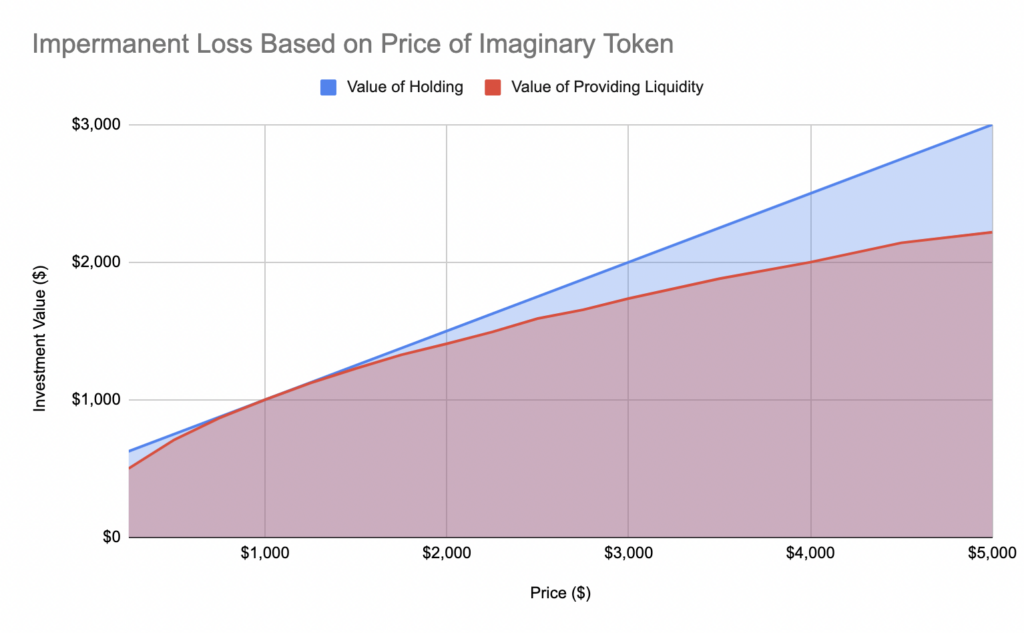
Based on the constant pricing function we can expect to receive: 1,118 DAI ($1,118) and 0.22 Imaginary Token ($1,118) for a total value of $2,236. Comparing this value to the hypothetical value of the assets had we not provided liquidity displays with the concept of impermanent loss. If we hadn’t provided liquidity, we would have 500 DAI ($500) and 0.5 Imaginary Token ($2,500) for a total value of $3,000. As we can see, impermanent loss equals $767 ($3,000 – $2,236).
Why Is It Called Impermanent Loss?
Impermanent loss is labelled as ‘impermanent’ because it can hypothetically be recouped if asset prices return to their previous values. The loss becomes permanent once you withdraw your liquidity and cannot be recouped without making additional trades or investments.
Impermanent loss in 2026: what has changed
The maths in the worked example above has not changed. What has changed is the tooling. In September 2026, the Research Hub recorded that Uniswap launched a tool that adjusts liquidity provider fees for stablecoin pairs based on market conditions, rather than using a fixed rate.
Stablecoin pairs carry little impermanent loss because both tokens aim to stay near the same value. Pairs with a volatile token carry more, and the Knowledge Hub lists free calculators that estimate the loss for a given price move before you deposit.
- Estimate impermanent loss with a calculator before depositing.
- Compare expected fees with the possible loss.
- Stablecoin pairs carry less price divergence risk.
- Check which platform and fee tier the pool uses.
Watch: Ben Simpson on this topic
Key takeaway: Ben explains how people earn income on their crypto, including liquidity pools, and the risks to understand first.
How Collective Shift explains impermanent loss to members
When members ask whether providing liquidity is income, the team’s answer is that fees are only part of the picture. If one token runs hard in either direction, the pool effectively sells it on the way up or buys more on the way down, and the fees need to outpace that loss.
- Fees are not the whole return.
- Volatile pairs mean more divergence.
- Understand the risk before depositing.
The fees you earn need to outpace that loss, and in a volatile pair that is not guaranteed.
Paraphrased from Collective Shift team answer to a member question on liquidity pools (March 2026)
Where this guide comes from
This guide is written and reviewed by the Collective Shift research team. Collective Shift is a crypto research and education company founded in 2020 in Melbourne, and a research and education partner to Coinbase, Swyftx and CoinSpot. Sources used in this update:
- Video: How To Earn Income On Your Crypto (Without Getting Wrecked), Ben Simpson on YouTube (2026-04-06)
- Collective Shift Knowledge Hub: Member Q&A: Liquidity Pools and Impermanent Loss, XAUT/USDT Analysis (13 Mar 2026) (ref eb79dc23)
- Collective Shift Knowledge Hub: Knowledge Hub tool profile: Observable IL Calculator (May 2026) (ref 0039d9fb), original source: observablehq.com
- Collective Shift Knowledge Hub: Research Hub: Uniswap launches dynamic fee tool for stablecoin pairs, The Defiant (11 Sep 2026) (ref 43fcbfa6), original source: thedefiant.io
Last updated 30 October 2026. General information only, not financial advice. Consider your own circumstances and seek professional advice before making investment decisions.
Frequently Asked Questions
Is impermanent loss permanent?
It becomes permanent if you withdraw while prices have diverged. If prices return to where they were when you deposited, the loss shrinks or disappears.
Do stablecoin pools have impermanent loss?
Very little, because both tokens aim to hold the same value. The risk grows with the price volatility between the two tokens.
Where can I learn about earning income on crypto?
The Collective Shift Accelerator membership is a 12-month guided program that starts with 4 live weeks and covers DeFi, liquidity and risk management. More free guides are on Collective Shift Insights.